Share Now:
Walking into a behavioral health clinic today, you’ll see staff navigating multiple platforms handling documentation, scheduling, communication and reporting. It’s overwhelming. You’ve probably heard about EMR vs EHR and perhaps even CRMs and wondered what each one really does. Which one is right for your practice? The short answer: it’s not about picking one, it’s about understanding how they can work together to power your care. Let’s unpack these systems line-by-line, with real-world stories and practical insights.
Behavioral health is different. Sessions are often long, sometimes 60 or 90 minutes. Clients return week after week (or year after year). And notes aren’t just basic checklists; they’re narrative overviews capturing emotional tone, context, progress and therapy goals. Layers in insurance requirements, privacy rules, referral coordination and patient engagement and you realize traditional charting fall short.
Providers need tools that support relationships, not just data entry. That’s where EMRs, EHRs and CRMs each play a role.
An EMR is simply a digital file where a healthcare provider keeps patient notes, diagnoses, medications and session summaries. Think of it as a digital version of the classic paper file kept in a single provider’s office.
Unlike more connected systems, EMRs are built to serve one purpose: keeping track of clinical notes for internal use. They’re usually used by solo practitioners or small practices because they’re straightforward, lower in cost and don’t require a huge setup.
An EHR is built for a more connected system of care. It holds all the information an EMR would, but expands beyond a single provider. It includes lab results, medication histories, allergies, imaging records and more and it’s designed to be shared between clinics, hospitals, specialists and labs.
EHRs are useful for behavioral health centers that involve multiple providers like therapists, psychiatrists and case managers working together.
| Feature | EMR | EHR |
|---|---|---|
| Scope | Documentation in one clinic | Shared record across providers |
| Data Sharing | Limited or manual | Standardized and interoperable |
| Patient Engagement | Few built-in tools | Patient portals & communications |
| Comprehensive Care | Single-provider focused | Whole-person, multi-provider |
| Compliance & Reporting | Basic | Supports billing, compliance |
| Cost & Complexity | Lower, simpler | Higher, more complex |
Behavioral health care is deeply personal. You build trust. You follow progress. You adapt treatment plans. EMRs and EHRs handle records but often don’t support the day-to-day administrative dance:
Essentially, EMRs/EHRs aren’t built for relationship-driven workflows. This leads to missed appointments, wasted staff effort and inconsistent patient experiences.
CRM stands for Customer (or Client) Relationship Management. In behavioral health, it’s tailored to support:
In short: a Behavioral Health CRM supports the relationship from first contact to ongoing care.
We built our Behavioral Health CRM to solve these exact pain points.
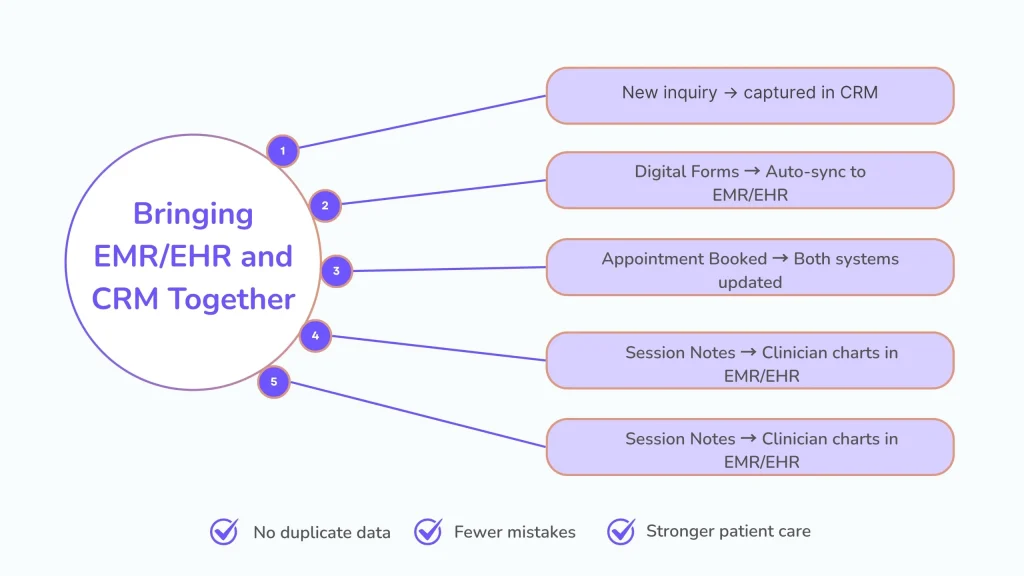
All while syncing with your EMR/EHR so clinicians experience seamless documentation.
| Feature | EMR | EHR | Behavioral Health CRM |
|---|---|---|---|
| Documentation | Basic notes and visits | Full clinical records | Notes not primary, supports docs |
| Data Sharing | Within your clinic only | Multi-provider exchange | Syncs with EMR/EHR |
| Patient Portal/Engagement | Minimal | Standard tools | Full engagement & reminders |
| Intake Process | Manual forms | Basic sun-screens | Digital forms, onboarding flow |
| Lead Management | N/A | N/A | Captures and nurtures inbound leads |
| Administrative Automation | Scheduling & billing | Moderate workflows | Automated communications & workflows |
| Cost | ~$1,500–$5,000 upfront revenuexl.com |
~$1,200/provider/year ehrinpractice.com |
$50–150/user/month, ROI from reduced no‑shows |
| Best Fit | Solo/small practices | Multi-provider clinics | All sizes where client retention matters |
¹Costs depend on number of users, type of deployment and features.
For true efficiency, you don’t have to replace everything — you just integrate.
Your systems work together, no duplicate data, fewer mistakes, better care.
Every tool you choose must be secure, encrypted and compliant.
Together, they form a digital ecosystem supporting clinicians, administrators and clients alike, with harmony, efficiency and scalability.