Share Now:
Many facilities have reported that a great % of behavioral health patients drop out during fragmented intake processes, costing facilities millions annually. This challenge stems from inefficient admissions workflows, poor lead attribution and compliance risks leading to log conversion cycles. To address this, behavioral health organizations must enhance patient intake by simplifying workflows, improving lead management, and ensuring a smooth, compliant admissions experience.
A custom behavioral health CRM addresses these pain points by automating intake, improving referral tracking, and optimizing marketing spend.
As a C-level Executive of a high-performing facility, you can lead the change from a chaotic, manual set-up to a streamlined, technology-driven system that enhances patient retention and increases revenue.
This article explores how purpose-built CRMs unify marketing, referrals, and patient engagement while driving ROI.
Behavioral health facilities often struggle with inefficiencies in admissions and marketing.
Fragmented Admissions:
According to a report from the San Francisco Chronicle, 42% of individuals seeking detox services were not admitted within 24 hours due to intake inefficiencies
Blind Marketing Spend:
Lead Attribution Gaps:
Compliance Risks:
Impact:
A custom behavioral health CRM can resolve these issues by automating workflows and centralizing patient data.
A behavioral health-specific CRM addresses these issues through automation, data integration, and real-time insights:
By integrating these capabilities into one platform, facilities can reduce errors, enhance efficiency, and improve the patient experience.
Ensure that all patient information, including medical records, billing data, and referral details, is stored in a single location. This eliminates data silos, reduces duplication, and gives clinicians a comprehensive view of a patient’s treatment journey. With all relevant data easily accessible, care teams can collaborate more effectively and provide better support.
Eliminate manual administrative tasks by triggering essential actions based on predefined rules. Tasks like insurance verification, appointment reminders, and referral follow-ups happen automatically, reducing staff workload and minimizing human errors. Automation also improves the patient experience by ensuring timely communication and faster admissions processing.
Provide valuable insights into facility performance, helping decision-makers track referral-to-admission rates, marketing ROI, and staff efficiency. By analyzing data trends, facilities can identify gaps, optimize resource allocation, and make data-driven decisions that enhance both financial and operational outcomes.
Allows seamless integration with electronic health records (EHRs), telehealth platforms, and eBenefits systems. This connectivity ensures that patient data flows smoothly across systems without requiring manual entry, reducing errors and maintaining compliance with HIPAA and other regulatory requirements. Facilities can provide a more connected and efficient care experience by linking their CRM with the tools they already use.
Ensures that the CRM can adapt to different behavioral health programs, whether for substance use treatment, mental health counseling, or adolescent care. As a facility grows or expands services, a scalable CRM can accommodate new workflows, additional locations, and evolving treatment models without the need for a complete system overhaul. This flexibility makes it a long-term investment that supports both current needs and future growth.
Explore how one detox facility reduced lost leads and improved admissions by 30% within few months
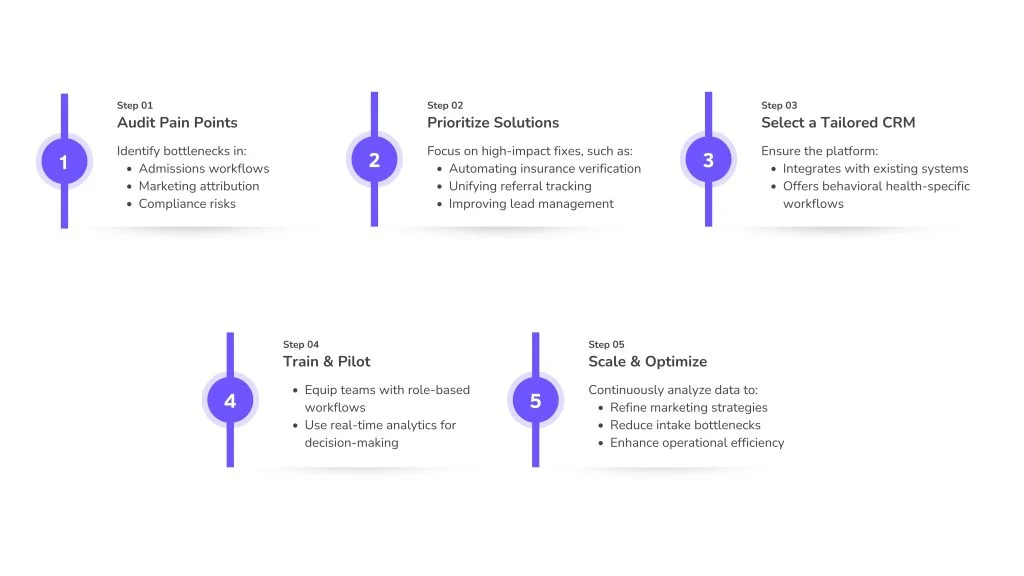
To successfully adopt a behavioral health CRM, facilities should follow a structured implementation approach:
Identify bottlenecks in:
Focus on high-impact fixes, such as:
Ensure the platform:
Continuously analyze data to:
Technology is evolving rapidly, and behavioral health facilities must keep up to provide better patient care, reduce administrative burdens, and improve outcomes. In the coming years, CRMs will become even more powerful, with AI, telehealth, and advanced data security playing a major role.
Artificial intelligence (AI) will help facilities identify high-risk patients early, allowing for timely interventions.
For example, if a patient has a history of missed appointments, the CRM can trigger an alert for staff to reach out proactively, preventing a potential dropout.
The rise of telehealth has made it easier for people to access mental health and substance use disorder treatment. CRMs will seamlessly integrate telehealth into the intake process, making it:
Imagine a patient fills out an online intake form, submits insurance details, and schedules a telehealth appointment, all within the CRM. This kind of automation will reduce wait times, improve patient experience, and boost admission rates.
As CRMs collect more data and use AI-driven insights, maintaining trust and compliance will be critical.
The future of patient intake is about smarter, more connected systems that make the process faster, easier, and more effective—without sacrificing privacy or the human element of care.
Behavioral health facilities can no longer afford inefficient, disjointed admissions processes. A custom CRM eliminates silos, improves efficiency, and turns admissions into a strategic asset.
Platforms like Binario’s Behavioral Health CRM, powered by Salesforce, offer:
✅ HIPAA-compliant automation
✅ Referral tracking and marketing optimization
✅ Seamless intake management
Audit your intake process today—every missed lead impacts your revenue. Explore how a behavioral health CRM can transform your operations.