Share Now:
Chart reviews are essential for compliance and quality care in behavioral health clinics. However, continuing to automate chart reviews manually in a behavioral health facility can be overwhelmingly time-consuming, costly, and error-prone. There are so many records in a client chart – and so little time.
You need a team of compliance officers, medical records staff, clinical supervisors, billing and coding specialists, external consultants – and someone to supervise them all. That’s probably you.
Have you recently asked yourself:
✅ How many hours per week does my staff spend on chart reviews?
✅ What percentage of our audits result in penalties, claim denials, or rework?
✅ Are our current tools scalable enough to meet 2025 compliance demands?
As value-based care and stricter regulations rise, outdated workflows strain staff, risk compliance, and lead to revenue losses. With AI-driven automation reshaping healthcare, 80% of clinics will automate chart reviews by 2025 to stay competitive and compliant.
If your clinic is still relying on manual documentation review, you might be paying a much higher price than you realize.
Healthcare professionals’ primary job is to help patients, not push paperwork. Yet, clinicians spend an average of 2.6 hours every day on clerical tasks.
For behavioral health providers, this means:
Burnout is a major consequence of this administrative overload. According to the American Medical Association, 70% of physicians report data fatigue, citing excessive documentation requirements as a major factor in burnout.
The financial implications of manual chart reviews are substantial. Clinics often experience revenue loss due to billing inefficiencies, delayed claims, and compliance penalties.
Delayed or denied reimbursements can severely impact a clinic’s financial health, making it harder to invest in patient care and staffing.
Manual documentation review doesn’t just affect clinic operations; it also delays crucial interventions and increases the risk of medical errors.
If your clinic still relies on manual chart reviews, you’re not alone—but the numbers show that the industry is rapidly shifting:
As regulatory bodies tighten compliance requirements, behavioral health clinics must either adapt or face the consequences.
New regulations are pushing clinics toward digitization. The 21st Century Cures Act mandates better data accessibility, while FHIR standards require seamless electronic data exchange. Compliance bodies like CMS and Medicaid are shifting toward value-based care, demanding accurate and timely documentation for reimbursement.
At the same time, staffing shortages are worsening. With a 20% increase in demand for behavioral health services since 2020, clinics struggle to keep up. 70% of clinicians report burnout due to administrative overload. Automating repetitive tasks is the only way clinics can scale efficiently.
AI-powered compliance solutions are eliminating inefficiencies in chart audits through Natural Language Processing (NLP), Machine Learning (ML), and predictive analytics.
Most critically, AI automates risk prioritization, flagging high-risk cases instantly and reducing workload by 61%. Instead of manually combing through patient records, clinicians can focus on critical cases and interventions.
Clinics already adopting automation are seeing 25%+ cost savings. Fewer claim denials mean better cash flow and revenue stability, while automated compliance tracking ensures adherence to CMS, HIPAA, and accreditation standards.
Beyond financial gains, automation improves clinician satisfaction and patient care:
With regulations tightening and AI technology becoming more accessible, manual processes are becoming obsolete. Early adopters of automation will lead the industry, while those who delay will face higher costs, compliance risks, and operational inefficiencies.
Check out how a SUD Treatment Center based in California saved ~2 hours of manual paperwork per day and achieve 100% compliance with detox check requirements after implementing Binario’s AI Chart Audit Solution.
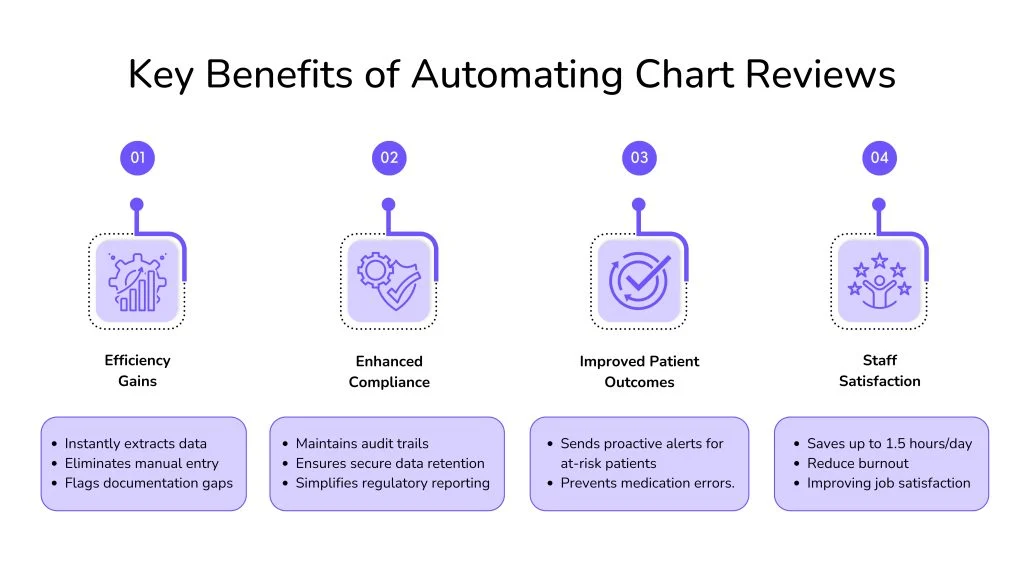
Manual chart reviews require hours of administrative work, delaying patient care and increasing the risk of errors. AI-powered solutions streamline this process by:
Regulatory audits are becoming more stringent, and failing to meet compliance standards can result in penalties or reimbursement losses. Automation ensures:
When documentation is incomplete or delayed, critical interventions can be missed, especially for high-risk patients. AI-driven audits improve care quality by:
Clinician burnout is a major issue, with excessive documentation workload being a key contributor. Automation helps by:
Reducing repetitive administrative tasks, leading to higher job satisfaction and lower staff turnover.
Transitioning from manual chart reviews to an AI-powered automated solution can seem overwhelming, but with a structured approach, clinics can streamline the process effectively. The key lies in evaluating current workflows, selecting the right technology, training staff, and tracking measurable improvements.
Here is the link to our FREE GUIDE to help you get started seamlessly.
The shift toward automation is no longer a choice, it’s an industry-wide necessity.
Clinics that embrace automation now will gain a competitive edge, ensuring better compliance, cost savings, and improved patient care. Those that delay risk falling behind, facing higher operational costs, compliance penalties, and staff burnout.
Ready to future-proof your clinic? Discover how Binario’s AI-driven chart audit solutions can transform your compliance and documentation workflows.