
February 25, 2026/
No Comments
Billing in behavioral health is not always clean. Most of the time it looks fine on the surface but when someone actually...
Behavioral health billing gets messy pretty fast once claims start getting denied. A lot of times people assume the treatment itself was the problem. But honestly, that is not usually what happens.
Most denials around h0004 happen because the documentation does not fully support the session the way payers expect it to.
And the frustrating part is that providers may have actually done everything right during treatment. The issue starts later when someone reviews the chart and things feel unclear, inconsistent or too thin.
Maybe the note sounds rushed. Maybe there is no real update on progress. Sometimes the timing does not fully match. Sometimes every session note sounds almost the same. Tiny stuff adds up.
Behavioral health teams already deal with enough during the day. Patients, scheduling issues, follow ups, insurance pressure, paperwork. Documentation usually gets squeezed somewhere in the middle of all that.
That is why codes like h0004 end up causing problems more often than people expect.
Binario Research works with behavioral health organizations that want cleaner documentation and fewer billing problems because once the same mistakes keep repeating, denials usually start repeating too.
Here are some of the most common documentation issues that often lead to h0004 claim denials.
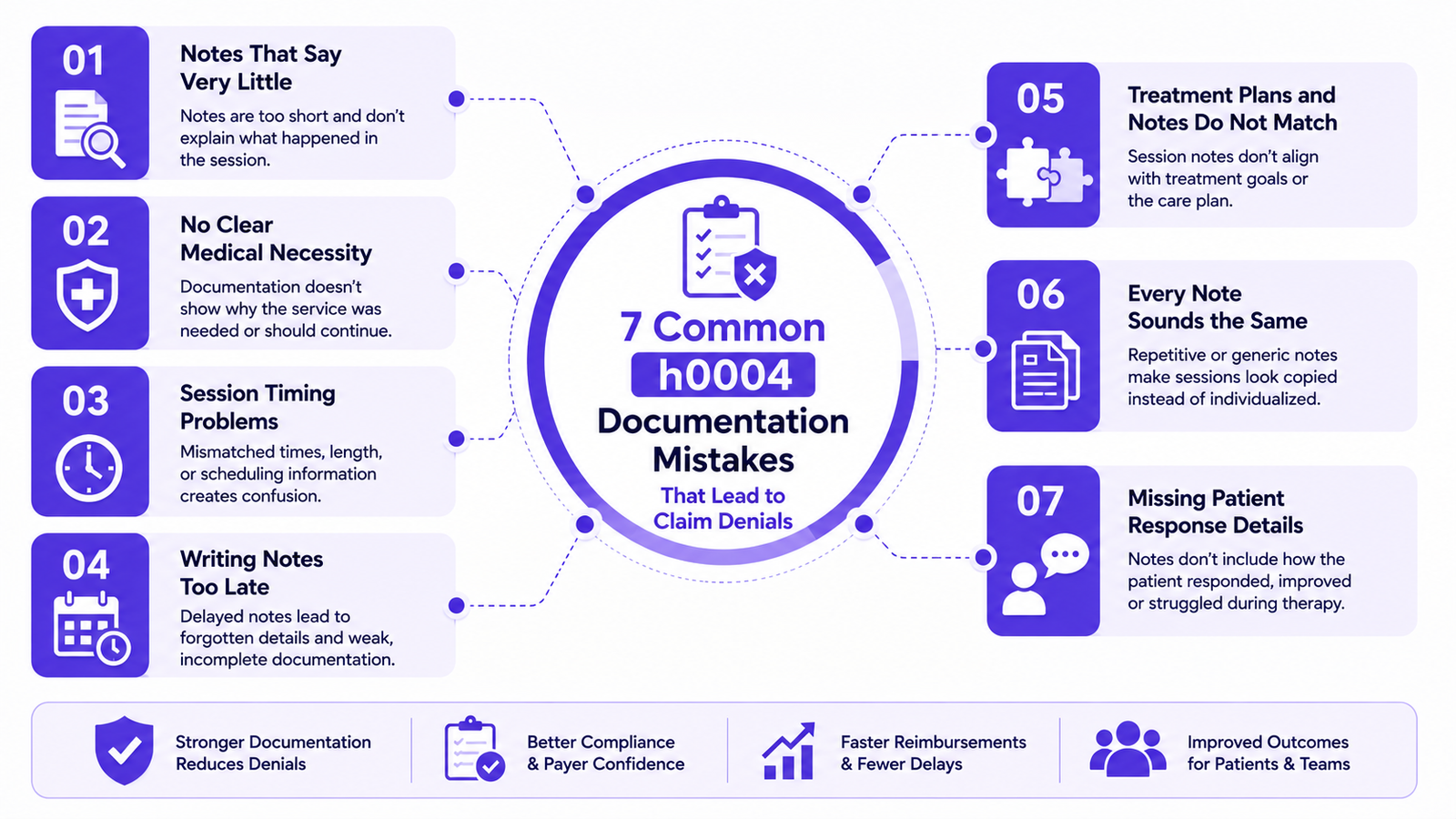
This happens all the time. The progress note technically exists but it barely explains anything about the actual session. Someone reading it later still cannot fully tell what happened.
A lot of notes end up sounding like:
And that is it.
The problem is that h0004 documentation usually needs more context than that. Reviewers want to see what was discussed, how the patient responded, whether symptoms changed or if treatment goals were addressed at all.
When every note sounds generic, the whole chart starts feeling weak.
Even when the treatment was completely real, the documentation can still end up looking weak if every note sounds repetitive or barely says much.
This is another big one. Just because a therapy session happened does not automatically mean it qualifies for reimbursement. The documentation still has to show why the service was needed.
A lot of providers focus mostly on describing the conversation itself but forget to explain the clinical reason behind continued treatment. That creates issues with h0004 claims later.
If the person reviewing the chart cannot really tell why therapy needed to continue, the claim can still get denied even when the session itself was completely fine.
Sometimes all it takes is a few missing details about symptoms, emotional functioning, setbacks or treatment needs.
Without that connection the documentation starts feeling incomplete.
This sounds small but it creates more trouble than people realize. Maybe the note says one session length while billing shows something different. Or the schedule looks packed in a way that does not fully make sense. Reviewers notice those things quickly.
With h0004, even small timing issues can make the whole chart feel a bit unreliable, even when it was just an honest mistake.
Sometimes providers document later in the day and forget exact times. Sometimes templates auto-fill information incorrectly. Sometimes people simply rush because they are behind.
Whatever the reason, mismatched timing creates unnecessary risk.
Most providers have probably done this at some point. The day gets busy. Documentation gets pushed back. Then later someone tries to finish multiple notes from memory.
That is where problems usually start. Details get forgotten. Sessions blend together. Notes become shorter and more general because the provider no longer remembers every part clearly.
And honestly, reviewers can usually tell when documentation feels rushed afterward.
With h0004, delayed charting often creates patterns where several notes sound nearly identical because someone was trying to catch up quickly.
That does not always mean bad care happened. It just weakens the documentation.
This one causes a lot of confusion during audits. The treatment plan says one thing but the actual session notes barely mention those goals again.
Maybe the plan focuses on anxiety management or emotional regulation but later notes never really connect back to those areas. Then reviewers start wondering if the treatment stayed aligned with the care plan at all.
With h0004, session notes should show some kind of movement toward treatment goals over time. Even small progress matters.
Without that connection the documentation starts feeling disconnected.
Templates help people move faster. That part makes sense. But sometimes providers rely on them so heavily that every note ends up reading almost exactly the same. That becomes risky pretty quickly.
If ten different h0004 notes repeat the same wording over and over, the chart starts looking copied instead of individualized.
Reviewers want documentation that reflects what actually happened during that specific session with that specific patient.
Even adding small personal details can make a difference. Something about mood changes, setbacks, reactions, stressors, progress, anything real.
The note does not need to sound perfect. It just needs to sound human.
A lot of notes explain what the provider did but forget to explain how the patient responded. Things like:
That missing piece matters more than people think. Without those details it becomes harder to show whether treatment was actually helping.
And with h0004, reviewers usually expect to see some kind of response pattern across sessions.
Otherwise the treatment can start looking repetitive without a clear purpose.
Honestly, most of this comes down to pressure and workload.
Behavioral health teams already manage heavy schedules every day. Documentation often happens between sessions, late in the evening or during whatever small gaps people can find.
That makes consistency harder.
According to the NIMH, about 1 in 5 adults in the U.S. experience mental illness in a given year, which keeps the demand for behavioral health services and documentation fairly high across different care settings.
As patient volume increases, paperwork pressure usually increases too.
That is why many organizations now use internal audits and documentation review systems more regularly. They just try to catch problems earlier now instead of waiting for denied claims to stack up later.
AI Chart Audit Tool from Binario Research helps behavioral health teams review documentation patterns before billing issues turn into larger reimbursement problems.
Most h0004 claim denials do not happen because treatment was missing. They happen because the documentation around the treatment feels incomplete, inconsistent or unclear once someone reviews it later.
And usually it is not one giant mistake either. It is smaller things stacking together. Generic notes, missing progress updates, weak medical necessity details, timing inconsistencies or repetitive wording.
Over time those patterns start hurting reimbursement.
The good thing is that most of these issues can improve once teams notice the patterns early and tighten documentation habits a little.
Not perfect documentation. Just clearer documentation that actually reflects what happened during treatment.
Billing in behavioral health is not always clean. Most of the time it looks fine on the surface but when someone actually...
Behavioral health billing gets messy pretty fast once claims start getting denied. A lot of times people assume the treatment itself...
Behavioral health organizations already have too much going on most days. Staff answer calls while finishing notes. Someone asks for...